
Quick Summary:
- Centralizes Field Operations – Field Service Management Software brings scheduling, dispatching, tracking, and reporting into one unified platform, eliminating manual coordination.
- Boosts Technician Productivity – Mobile apps provide real-time job details, directions, and checklists, helping technicians complete more jobs with fewer delays.
- Improves Customer Experience – Automated updates, accurate ETAs, and faster service create higher customer satisfaction and stronger retention.
- Increases First-Time Fix Rates – Access to job history, inventory, and diagnostics ensures technicians arrive prepared, reducing repeat visits and costs.
- Accelerates Business Growth with TejoServ – With real-time tracking, smart scheduling, and instant invoicing, TejoServ helps businesses reduce downtime, improve cash flow, and scale operations efficiently.
If you are running a service-based business in India, be it HVAC, telecom, IT maintenance, construction, or any field operations, managing your on-ground team is challenging. In this blog, we will explain what field service management software is, why Indian businesses are rapidly adopting it in 2026, the key benefits of field service management software, and how TejoServ specifically helps you solve everyday operational challenges. Whether you are a small business owner or managing a large service workforce, this guide is written for you.
What is Field Service Management Software?
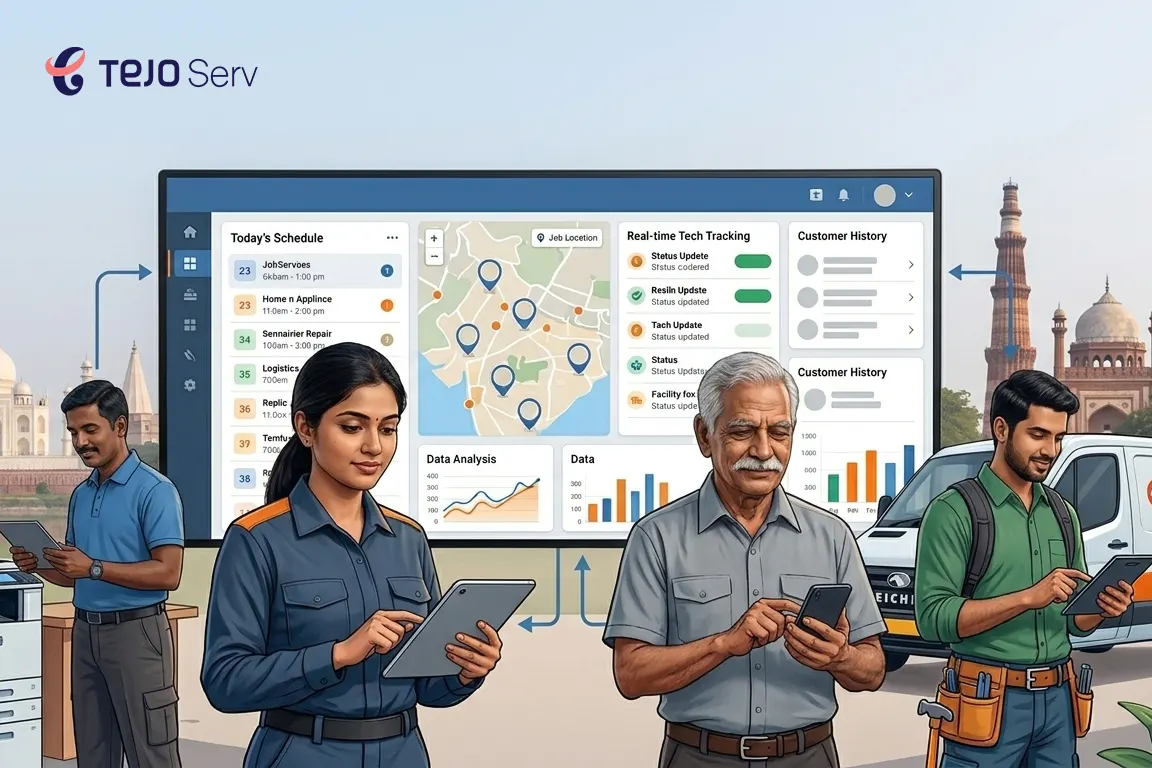
Field service management software is a digital platform that helps businesses plan, manage, track, and optimize their field workforce and operations. Think of it as your operations command centre.
A good FSM software brings together:
- Work order management – creating, assigning, and closing service jobs digitally
- Technician scheduling and dispatch – the right person to the right job at the right time
- Real-time GPS tracking – know exactly where your team is, always
- Customer communication – automated updates, service confirmations, and feedback collection
- Inventory and parts management – track what is available and what needs restocking
- Reports and analytics – make data-backed decisions instead of gut-feel ones.
Traditionally, these tasks were split across multiple tools or done manually. FSM software brings them all under one roof.
Modern FSM platforms now integrate mobile workforce applications, AI-driven scheduling engines, IoT-enabled asset diagnostics, and cloud-native service orchestration, helping businesses reduce service downtime and improve first-time fix rates.
In India, industries like telecom, manufacturing, real estate, utilities, and home services are the early and heavy adopters of FSM tools.
The Growing Demand for FSM in India And Why It Matters Right Now
Let us be honest. Managing field technicians with WhatsApp messages, Excel sheets, and phone calls worked fine five years ago. But today? It is simply not enough.
Indian businesses are scaling faster than ever. Customers expect real-time updates. Technicians need clear job assignments. Managers want live tracking and reports not end-of-day guesswork.
India is projected to grow at a remarkable 21.4% CAGR through 2033 in the FSM adoption space, driven by high digital readiness, with 71% of Indian employees showing advanced digital maturity. That is a signal for every Indian business owner to take field service management seriously right now.
Key Benefits of Field Service Management Software for Indian Businesses
Now that we understand the basics, let us get to the part every business owner actually cares about, what does it do for your bottom line?
1. Your Team Stops Wasting Time
When job assignments happen through a mobile app instead of phone calls, your technicians know exactly what to do, where to go, and what to carry. No more back-and-forth. No more missed jobs.
2. Customers Actually Feel Taken Care Of
In today’s competitive market, a customer who receives a real-time update “Your technician is 10 minutes away” is a happy customer. Happy customers come back and refer others. FSM software makes this kind of proactive communication effortless.
3. First-Time Fix Rates Go Up
One of the most costly things in field service is a second visit. When your technician goes unprepared without the right parts or information it costs you time, money, and the customer’s trust. FSM software ensures your team always has the job history, required tools, and checklist ready before they arrive.
4. You Can Finally Track Everything in One Place
Live job status, technician location, pending work orders, completed tasks, pending invoices all visible from a single dashboard. No more calling five people to understand what happened with one customer.
5. Billing and Invoicing Gets Faster
When a job is completed in the field, the invoice can be raised on the spot. No delays. No lost paperwork. Money comes in faster.
6. Smarter Decision Making
With proper reports of who is completing the most jobs, which areas have the highest service requests, which equipment breaks down most often you can plan your team, stock, and routes much more intelligently.
Currently, 48% of employers globally use FSM software, and this number is projected to reach 70% by 2027 as AI capabilities make these tools increasingly essential for staying competitive. Indian businesses that adopt now will be ahead of the curve.
Challenges Indian Businesses Face Without FSM Software
Before we talk about TejoServ, let us acknowledge what life looks like without a proper system:
- Technicians calling the office multiple times a day for instructions
- Customers getting no updates and calling repeatedly to check status
- Managers spending 2-3 hours daily just coordinating schedules
- Service reports filled in manually sometimes inaccurately, sometimes not at all
- No visibility into pending vs. completed work orders
- Delayed invoicing leading to cash flow issues
Sound familiar? This is the reality for thousands of Indian service businesses today. And this is exactly the gap that TejoServ was built to bridge.
Introducing TejoServ – Built for the Way Indian Businesses Operate
TejoServ is a purpose-built Field Service Management App designed with the practical needs of Indian service businesses in mind. It is not an overcomplicated global tool with features you will never use. It is clean, practical, and built to work even in the ground realities of Indian operations.
Here is what makes TejoServ stand apart:
Mobile-First Design – Your technicians are always on the move. TejoServ’s mobile app lets them receive job assignments, update status, capture photos, collect customer signatures, and raise invoices all from their phone.
Smart Scheduling and Dispatch – Assign jobs based on technician location, skillset, and availability. Reduce travel time and increase jobs completed per day.
Real-Time Tracking – Managers get a live view of every technician and every active job. No need to call and ask.
Customer Communication – Automated notifications at every job stage. Fewer inbound calls. Better satisfaction scores.
Work Order and Inventory Management – Create, close, and track work orders digitally. Monitor spare parts usage and get low-stock alerts.
Business-Ready Reports – Job completion rates, technician performance, SLA compliance, and more at your fingertips.
Conclusion
Managing your field team on phone calls and spreadsheets is holding your business back. Your competitors are going digital. Your customers already expect it. And tools like TejoServ have made it affordable and practical for Indian businesses of every size.
The benefits of field service management software are not theoretical, they are operational improvements you can see within weeks of going live. More jobs completed per day. Faster billing. Happier customers. Less chaos for your managers.
Ready to see how TejoServ works for your specific business? Book a free consultation with the TejoServ team today and get a personalised walkthrough for your industry and team size. No pressure, no jargon, just a straightforward conversation about how to make your field operations run better.
Frequently Asked Questions:
1. What is field service management software and how does it work?
Field service management software is a digital solution that helps businesses manage their on-site operations, including job scheduling, technician dispatching, tracking, and reporting. It works by centralizing all field activities into a single platform where managers can assign tasks and monitor progress in real time. Technicians use mobile apps to receive updates, complete work orders, and submit reports instantly, improving coordination, efficiency, and overall service delivery.
2. What are the main benefits of field service management software?
Field service management software improves operational efficiency, reduces manual errors, and enhances customer satisfaction. It allows businesses to automate scheduling, track technicians in real time, and manage work orders digitally. Additionally, it helps increase first-time fix rates, speeds up invoicing, and provides data-driven insights for better decision-making. These benefits ultimately lead to higher productivity, reduced costs, and improved service quality across field operations.
3. Why do businesses need a field service management app in 2026?
In 2026, businesses need field service management apps to keep up with rising customer expectations and rapid digital transformation. Customers expect real-time updates and faster service, while companies require better visibility and control over field operations. Manual processes like calls and spreadsheets are no longer efficient. FSM apps enable automation, real-time tracking, and mobile access, helping businesses stay competitive, improve service quality, and scale operations effectively.
4. How does field service software improve technician productivity?
Field service software improves technician productivity by providing clear job assignments, navigation support, and access to customer history through mobile apps. Technicians no longer rely on calls or paperwork, which reduces confusion and delays. With optimized scheduling and real-time updates, they can complete more jobs in less time. This streamlined workflow minimizes downtime and ensures technicians are better prepared for each service task.
5. What features should you look for in field service management software?
Key features to look for include work order management, job scheduling and dispatch, real-time GPS tracking, mobile access, inventory management, and reporting tools. Advanced features like AI-based scheduling, automated customer notifications, and integration with ERP systems can further enhance efficiency. Choosing software with these capabilities ensures better coordination, improved service delivery, and greater visibility into field operations.
6. How does TejoServ help improve field service operations?
TejoServ enhances field service operations by offering a mobile-first platform that simplifies job management and technician coordination. It provides smart scheduling, real-time tracking, and automated customer communication, reducing delays and confusion. Technicians can update job status, capture service details, and generate invoices directly from their mobile devices. This improves efficiency, reduces paperwork, and ensures smoother operations for both managers and field teams.
7. Can small businesses benefit from field service management software?
Yes, small businesses can significantly benefit from field service management software. It helps them organize operations, reduce manual work, and improve service delivery without needing large teams. With better scheduling, faster invoicing, and improved communication, small businesses can compete with larger companies. FSM software also provides insights that help optimize resources and support growth, making it a valuable investment for scaling operations efficiently.
8. How does FSM software improve customer satisfaction?
FSM software improves customer satisfaction by providing timely updates, accurate service schedules, and faster response times. Customers receive notifications about technician arrival and job status, which builds trust and transparency. With better planning and access to customer history, technicians can resolve issues more effectively during the first visit. This leads to quicker service, fewer delays, and an overall improved customer experience.
9. What challenges can be solved using field service management software?
FSM software solves common challenges such as poor communication, inefficient scheduling, lack of visibility, and delayed invoicing. It eliminates dependency on manual processes like phone calls and spreadsheets, reducing errors and confusion. Businesses gain real-time insights into operations, enabling better coordination and faster decision-making. This results in improved efficiency, reduced operational costs, and smoother management of field teams.
10. Is field service management software suitable for all industries?
Field service management software is suitable for a wide range of industries, including HVAC, telecom, construction, utilities, healthcare equipment maintenance, and IT services. Any business that manages on-site service teams can benefit from FSM solutions. The software is adaptable and can be customized to meet industry-specific needs, making it a versatile tool for improving operational efficiency and service delivery across different sectors.
If you are running a service-based business in India, be it HVAC, telecom, IT maintenance, construction, or any field operations, managing your on-ground team is challenging. In this blog, we will explain what field service management software is, why Indian businesses are rapidly adopting it in 2026, the key benefits of field service management software, and how TejoServ specifically helps you solve everyday operational challenges. Whether you are a small business owner or managing a large service workforce, this guide is written for you.
Author Bio:

Nikita Govili
Content & Technical Writer at ExpandX
Nikita Govil is a skilled content and technical writer at ExpandX, bringing a strong background in software engineering to her work. She began her career as a software engineer in a multinational corporation, where she gained hands-on experience in diverse areas such as software testing, documentation, and project management. This technical foundation allows her to craft clear, insightful, and impactful content that bridges the gap between technology and business. At ExpandX, Nikita combines her writing expertise with her technical knowledge to deliver content that informs, engages, and supports clients in the manufacturing and ERP domains.
