Quick Summary 

1. Streamlines Production Workflows – Centralizes scheduling, tracks machine performance, and allocates labor efficiently to minimize delays.

2. Enhances Department Collaboration – Provides real-time updates across production, procurement, and finance teams, reducing miscommunication.

3. Optimizes Inventory and Supply Chain – Offers accurate, real-time stock data and demand forecasting, lowering costs and avoiding shortages.

4. Supports Data-Driven Decisions – Delivers actionable insights via dashboards for production, cost, and supplier performance analysis.

5. Ensures Quality and Compliance – Maintains standardized quality checks, audit trails, and regulatory compliance across all production units.

As a content and technical writer from Tejo EPR, I have been working closely with clients in the manufacturing sector. I’ve seen how implementing ERP software for manufacturing can transform business operations. Over the years, I’ve had the opportunity to work with several manufacturing companies across India, helping them understand how technology can simplify workflows, reduce delays, and enhance productivity. In this blog, I want to share my experiences, highlighting practical examples of how ERP systems have improved my clients’ workflow and the key ERP system benefits they have experienced.

Understanding the Need for ERP in the Manufacturing Industry

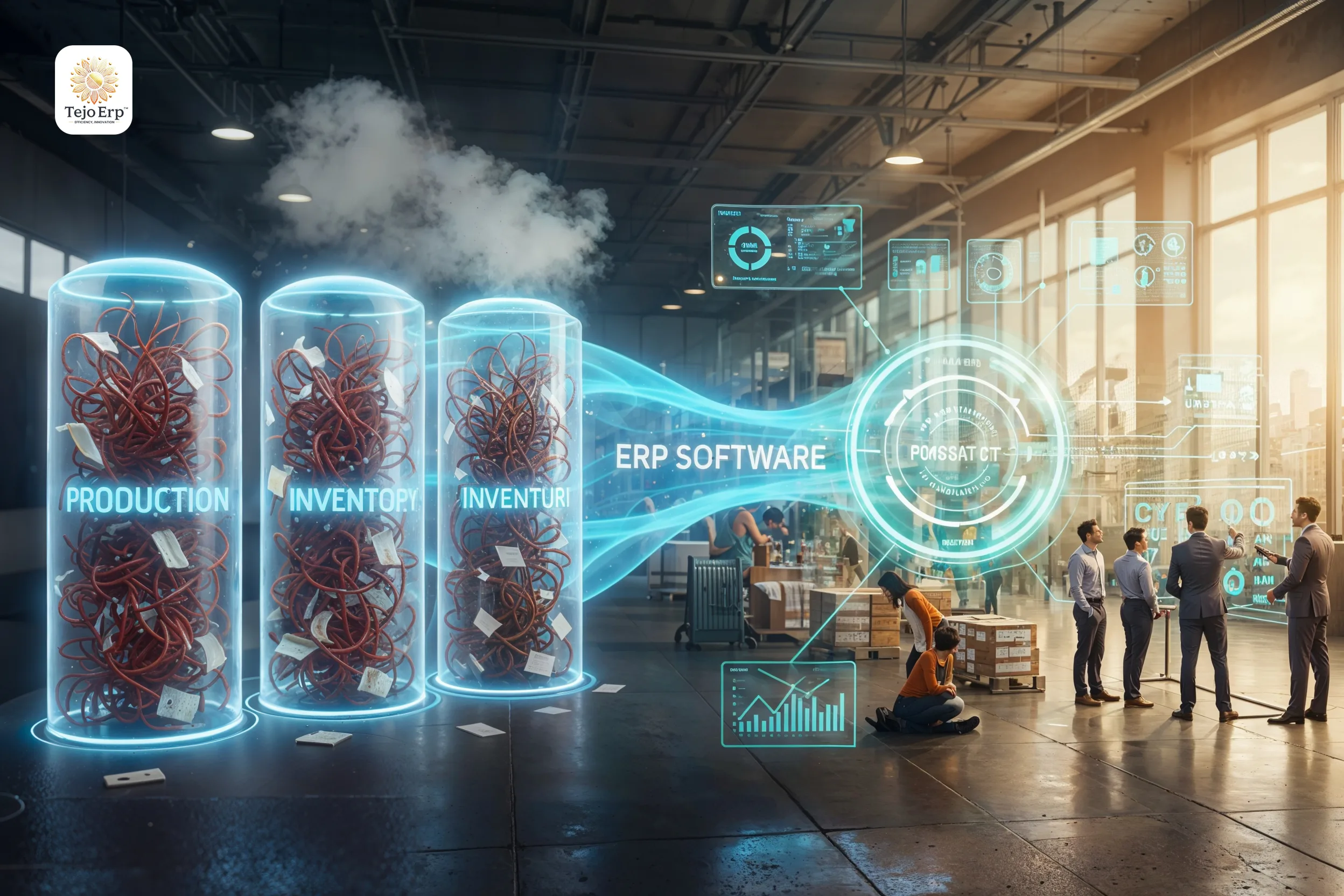
When I started working with manufacturing clients, one common challenge I found was disconnected processes. Production, inventory, procurement, and finance teams were working in silos, which led to delays, resource wastage, and miscommunication. In many cases, managers were completely dependent on spreadsheets and manual tracking, which made it hard to make quick and informed decisions.

These experiences highlighted the need for an integrative approach. ERP software consolidated everything onto a single platform, and I’ve seen companies transform their operations almost instantly.

Streamlining Production Workflows

One client I worked with was struggling with production scheduling. Machines were underutilized, and orders were getting delayed because departments were not communicating effectively. By implementing ERP software for manufacturing, we were able to centralize production schedules, track machine performance, and allocate labor efficiently.

The result? Production became smoother, and delays were minimized. Real-time monitoring allowed supervisors to quickly identify bottlenecks and reassign tasks, which significantly improved overall efficiency. It was rewarding to see the client achieve better output without increasing operational costs.

Enhancing Department Collaboration

Another area where ERP software made a huge difference was inter-departmental communication. For one of my clients, procurement and production teams often struggled to coordinate, which led to material shortages and unnecessary rush orders. With ERP, every department could access the same updated data.

I remember a scenario where the production team updated the completion of a batch, and the procurement and finance teams received automatic notifications. This eliminated confusion and improved responsiveness. Observing this transformation reinforced my belief in the erp system benefits, especially for Indian manufacturers managing multiple production units.

Optimizing Inventory and Supply Chain

Inventory management is often a pain point in manufacturing. I’ve seen clients either overstock raw materials, tying up capital, or face shortages that halt production. ERP systems solved this problem by providing accurate, real-time data on stock levels and supplier deliveries.

One client used this feature to forecast demand better and maintain optimal inventory. By integrating inventory management with production planning, they reduced wastage and avoided unnecessary costs. For manufacturers looking to cut costs further, I also shared insights from our previous work on how TejoERP can reduce costs in the manufacturing industry, which proved helpful in reinforcing the financial benefits of ERP implementation.

Making Data-Driven Decisions

Business team using ERP dashboard for data-driven decisions with real-time insights, optimized workflow, and performance analytics – Tejo ERP

A key part of my work involves helping clients understand the value of data. ERPs collect information from many departments and usually present actionable insights through dashboards. I have guided a few managers on how to analyze their production efficiently, track costs, or even evaluate the performance of suppliers with reports from the ERP. This keenness that can be achieved only by making decisions based on facts and not assumptions has made a difference in planning production, reducing mistakes, and improving overall workflow.

Ensuring Compliance and Quality Management

Quality and compliance are critical in manufacturing. I’ve seen how ERP systems help companies maintain detailed records of production, inspections, and audits. One client was able to standardize quality checks across all production units and comply with regulatory standards efficiently.

Having all information centralized made audits smoother and allowed managers to maintain consistent quality, which improved customer satisfaction. These experiences made me realize that ERP implementation is not just about efficiency; it’s also about building trust and credibility with clients and customers.

Conclusion: Experiencing the Benefits of ERP Firsthand

In my view, the effect brought by ERP software in manufacturing is more than process improvement – it is a total shift in the mode of operation. I have seen it work in action with improved workflow efficiencies, better collaboration, better inventory management, and data-centric decision-making. These are not just “fluff” benefits but things that help make manufacturers lower their costs, save time, and scale efficiently.

ERP solutions are something I would recommend exploring if your manufacturing operation is looking to streamline operations and boost overall productivity. Why not experience this firsthand with a free demo of Tejoerp. Take it for a spin and see how it could streamline your workflow just like it did for my clients.

Frequently Asked Questions:

ERP streamlines production scheduling, enhances communication between departments, and provides real-time insights, reducing delays and inefficiencies.

Companies face disconnected processes, manual tracking, and miscommunication. ERP centralizes data, enabling better coordination and decision-making.

Yes, by centralizing schedules and monitoring machine and labor performance, ERP minimizes bottlenecks and keeps production on track.

ERP provides real-time stock levels, forecasts demand, and optimizes procurement, preventing overstocking or shortages.

Absolutely. ERP dashboards present actionable insights on production, costs, and supplier performance, allowing data-driven decisions.

Yes, departments like production, procurement, and finance access shared data and automated notifications, enhancing communication and coordination.

ERP maintains standardized quality checks, records production and audits, and helps comply with regulatory requirements.

Yes, ERP systems can be scaled to fit the size and complexity of any manufacturing operation, improving efficiency and productivity.

Key benefits include streamlined workflows, better collaboration, optimized inventory, data-driven insights, and improved quality and compliance.

Author Bio:

Nikita Govili

Content & Technical Writer at ExpandX

Nikita Govil is a skilled content and technical writer at ExpandX, bringing a strong background in software engineering to her work. She began her career as a software engineer in a multinational corporation, where she gained hands-on experience in diverse areas such as software testing, documentation, and project management. This technical foundation allows her to craft clear, insightful, and impactful content that bridges the gap between technology and business. At ExpandX, Nikita combines her writing expertise with her technical knowledge to deliver content that informs, engages, and supports clients in the manufacturing and ERP domains.