
Quick Summary: How ERP Systems Streamline Warehouse Operations
1. Centralises All Distribution Tasks – Integrates purchasing, inventory, sales, and finance into one ERP warehouse management system for real-time visibility.
2. Improves Inventory Accuracy – Tracks stock movement automatically, reducing manual errors and stock discrepancies.
3. Speeds Up Order Processing – Automates order entry, invoicing, and dispatch to ensure faster, error-free deliveries.
4. Drives Data-Based Decisions – Generates actionable reports to help distributors forecast demand and optimise warehouse operations.
5. Boosts Efficiency and Scalability – Enhances productivity, reduces costs, and adapts easily as business operations grow.
As someone who’s worked closely with distributors implementing ERP systems, I’ve seen firsthand how the right technology can completely transform warehouse operations. Distributors often face challenges like stock mismanagement, delayed deliveries, and manual data errors that not only slow down operations but also affect customer satisfaction and profitability.


An ERP warehouse management system (WMS) enables distributors to streamline operations by integrating inventory, sales, and logistics into a single system. It highly automates manual tasks, brings about visibility in real-time over stock and order status, minimizes human errors, and improves overall productivity. Data-driven decision-making will generally empower distributors to enhance their operational efficiencies while cutting costs and thereby offering improved experiences to customers.
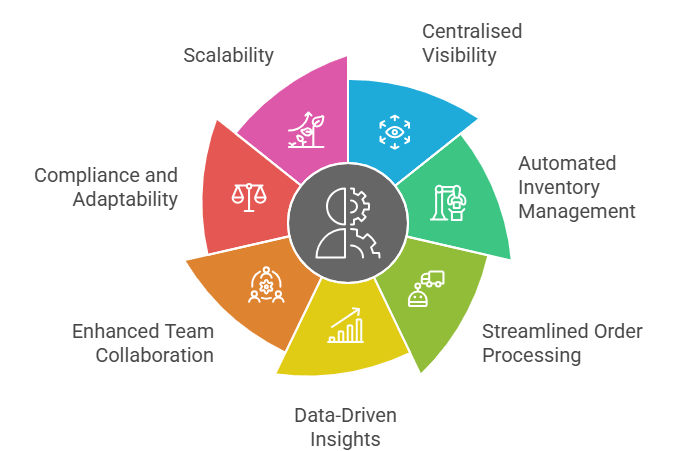
1. Centralised Visibility into Every Operation
One of my clients, a large FMCG distributor, was struggling with disconnected data across departments. Their sales team used spreadsheets, the warehouse used manual stock books, and finance worked on standalone software. This fragmentation often caused miscommunication and delays in fulfilling customer orders.
When they adopted an ERP for distributors, the impact was immediate. Suddenly, all departments were connected from procurement to dispatch. The ERP provided real-time visibility into stock levels, pending orders, and financial records, all within one unified dashboard.
This integration reduced dependency on manual updates and ensured that the management team could track performance across multiple warehouses effortlessly. If you’re looking for such seamless integration, explore the ERP for Distributors solution by TejoERP. It’s designed specifically for distribution businesses in India.
2. Reducing Manual Errors with Automated Inventory Management
Another major advantage of ERP systems is inventory accuracy. Before implementation, many distributors rely on manual counting, which is prone to human error. With ERP, every stock movement from goods receipt to dispatch is recorded automatically.
I recall one instance where a client’s warehouse team struggled with frequent stock mismatches. Once the ERP warehouse management system was deployed, they started using barcode scanning and real-time tracking. Within weeks, discrepancies dropped drastically.
Now, their inventory reports are generated instantly and accurately. No more surprise shortages or excess stock. For Indian distributors managing multiple product lines, this kind of automation not only saves time but also improves cash flow by optimising stock levels.
3. Streamlining Order Processing and Delivery
Efficient order management is at the heart of successful distribution. Without proper systems, tracking orders across multiple regions can be messy. ERP systems simplify this by automating the entire process from sales order creation to delivery and invoicing. One of my clients, a regional hardware distributor, cut order processing time by nearly 40% after implementing ERP.
Here’s how: once an order is entered, the system checks stock availability, reserves items, generates an invoice, and updates delivery schedules automatically. It even alerts the sales team if an item is out of stock or delayed. This level of automation allows distributors to fulfil orders faster and with greater accuracy, which directly improves customer satisfaction, something every Indian distributor aims for.
4. Data-Driven Insights for Smarter Decisions
One thing I often tell my clients is that ERP is not just a tool for automation; it’s a platform for decision-making. ERP gives sales, inventory, and margin analysis on a granular level to the distributor. Management will also have instant views of product performance, stock situations relating to slow-moving inventory, or any area in which operational costs might be further reduced via customized dashboards.
For example, one client used this information in renegotiating supplier terms after identifying that slow-moving inventory was tying up capital. Another discovered a high-performing product line that subsequently became their primary growth driver. Such decisions cannot be made without real-time ERP insights proving why the best ERP for wholesale distribution is more than just software; it is a business intelligence partner.
5. Enhancing Team Collaboration
In distribution, coordination between departments is critical. Sales, warehouse, logistics, and finance must stay in sync, and that’s exactly what ERP makes possible. I’ve observed how ERP transforms team communication. When a sales order is created, the warehouse gets instant visibility, the finance team prepares the invoice, and management tracks progress in real time. No more endless phone calls or waiting for updates.
The ERP for distributors solution from TejoERP, for instance, is designed to promote this level of collaboration by ensuring every team member works with up-to-date data.
6. Compliance and Local Adaptability
For Indian distributors, compliance with GST and other statutory requirements is a big concern. Manual filing can be time-consuming and error-prone. Modern ERP systems come equipped with automated tax calculation and GST integration, reducing compliance headaches. During one project, a client’s finance team was able to generate tax-compliant invoices and file GST returns directly through the ERP, saving days of effort each month.
7. Scalable for Growing Businesses
The distribution business involves complex business processes that need to handle more orders, new products, and additional warehouses. The ERP should be flexible to grow along with your business.
I have seen small distributors expanding from a single warehouse to operations in multiple states using the same ERP. Traveling owners or owners of multiple branches find cloud-based ERP solutions very handy because they can access them from anywhere.
Investing in an ERP management system for the warehouse that is scalable will grow with you, no matter how fast your business grows.
Conclusion
Working with distribution clients across India has shown me how technology can drive real transformation. The right ERP warehouse management system eliminates repetitive manual work, improves data accuracy, and empowers teams to make informed decisions.
If you’re a distributor looking to simplify your operations, enhance visibility, and scale confidently, implementing the best ERP for wholesale distribution is the step forward.
Learn more about how TejoERP for Distributors can help you streamline operations and grow efficiently in the Indian market.
Frequently Asked Questions:
1. What is an ERP warehouse management system?
An ERP warehouse management system (WMS) is software that integrates inventory, order, and logistics management into one platform, helping distributors automate and monitor all warehouse operations.
2. How does ERP help distributors improve efficiency?
ERP automates repetitive tasks like stock updates, billing, and order tracking. This saves time, reduces manual errors, and improves coordination between departments.
3. Why is ERP important for warehouse operations?
ERP provides real-time visibility of stock levels, purchase orders, and shipments, allowing distributors to make quick and accurate decisions while reducing downtime.
4. Can small distributors use ERP systems?
Yes, modern ERP systems are scalable and can be tailored for small and mid-sized distributors, making them cost-effective and easy to implement.
5. What are the key features of ERP for distributors?
Essential features include inventory control, sales order management, purchase tracking, warehouse automation, analytics, and GST-compliant billing (for Indian distributors).
6. How does ERP improve inventory management?
ERP ensures accurate stock tracking with barcode integration and real-time updates, preventing overstocking or shortages.
7. What are the benefits of using the best ERP for wholesale distribution?
Benefits include faster order fulfillment, better data accuracy, reduced operational costs, and improved customer satisfaction.
8. Is an ERP warehouse management system suitable for Indian businesses?
Yes, ERP solutions designed for India support GST compliance, regional taxation, and multi-location operations, making them ideal for Indian distributors.
9. How does ERP help in decision-making?
ERP systems generate data-driven insights and custom reports that help management identify trends, forecast demand, and make smarter business decisions.
10. What should distributors look for when choosing an ERP system?
Look for features like scalability, user-friendly interface, cloud accessibility, and integration with existing sales and finance tools.
Author Bio:

Nikita Govili
Content & Technical Writer at ExpandX
Nikita Govil is a skilled content and technical writer at ExpandX, bringing a strong background in software engineering to her work. She began her career as a software engineer in a multinational corporation, where she gained hands-on experience in diverse areas such as software testing, documentation, and project management. This technical foundation allows her to craft clear, insightful, and impactful content that bridges the gap between technology and business. At ExpandX, Nikita combines her writing expertise with her technical knowledge to deliver content that informs, engages, and supports clients in the manufacturing and ERP domains.
